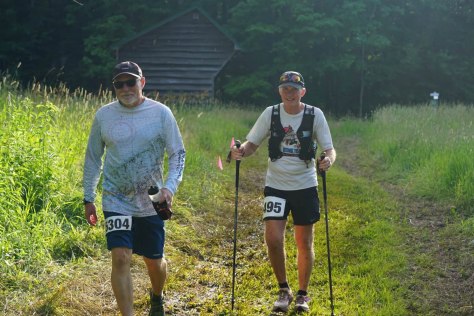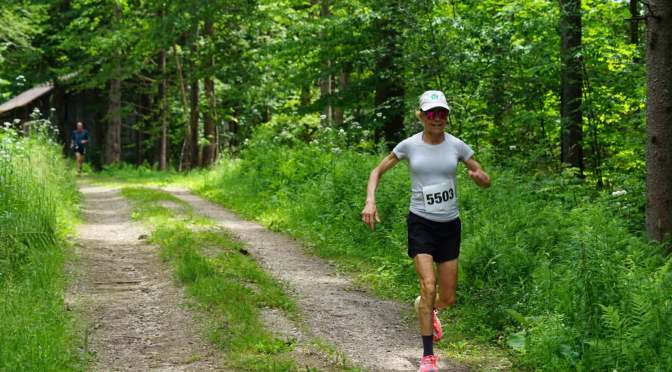
WINDSOR, Mass. – In recent years, runners at the Notchview Ultra have had to endure wet conditions at some point during the multi-day event with at least one round of rain soaking the course and turning parts of the trail slippery. Most notably, the 2023 edition concluded with 24 consecutive hours of downpour when monsoon-like conditions brought flooding and extensive damage to parts of western Massachusetts and nearby Vermont.
Runners enjoyed a reprieve from the rain at this year’s event, and they capitalized on some of the finest weather in Notchview Ultra history by unleashing a different type of storm–a monsoon of mileage–during the 11th edition of the event on July 10-13 at Notchview Reservation in Windsor, Mass.
This year’s event included its traditional 100.7-mile, 72-hour, 48-hour, 24-hour, 12-hour and 6-hour races as well as a new overnight 12-hour race, with 250 runners toeing the starting line across the various offerings. On a calm, dry weekend where temperatures only reached the upper 70s, course records fell in nearly every category, a record number of runners surpassed the 200-mile mark in the 72-hour race, and race director Benn Griffin handed out a record 100 belt buckles to runners who completed 100 miles or more at the various distances.
Many of the runners made the miles look easy, clicking away lap after lap through the daytime hours as well as while running through the night by the glow of headlamps. Still, over the course of multiple days of running and asking their bodies to rally for more, each runner encountered adversity and had moments where digging deep was necessary to continue onward and achieve their goals. Perhaps nobody embodied that more than the runner who spent the most time hammering the loop: Benjamin Niebla. The 29-year-old from Manchester, N.H., already knew the Notchview loop quite well, having run the 12-hour race in 2024 as his third ultra before returning and winning the 100.7-miler in course-record time (19:44:43) in 2025. This year Niebla entered the 72-hour race, and he aimed big.
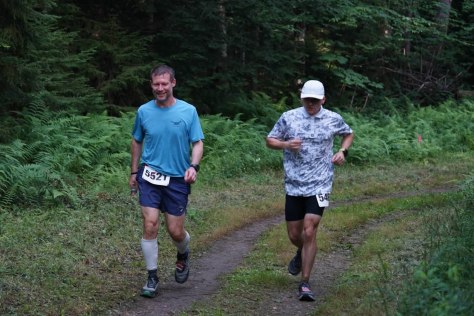
“I certainly have been blessed on this course,” Niebla explained. “My relationship with ultrarunning has had a few pivotal moments, and one of those moments occurred last year in the 100-miler. I had an extremely lofty goal of hitting the 300-mile mark going into the race this year, which was a little unrealistic at the moment. I tend to aim high; sometimes I hit the target, and other times I miss in spectacular fashion. I was confident enough in my abilities going into the race that I should have been able to hit 250 miles as the minimum. I certainly underestimated that a bit, because it was a little more difficult than I thought.”
Niebla’s goal was ambitious–Brian Papay set the course record of 250.8 miles in 2025–but he didn’t hold back. He approached the race by focusing on maintaining a rate of perceived exertion that felt easy, and it worked well for the first 32 hours as he cruised through 69 laps and 131 miles, frequently calling out encouragement to other runners as he passed. It was at that point that Niebla’s relaxed pace and good vibes were nearly derailed not due to a miscalculation in his approach, rather due to his shoes being laced too tight.
“The single biggest issue I encountered at this race was a massive structural failure at mile 130. It turned out I tied my new shoes way too tight, and it strained the tendons on the tops of my feet severely,” he recalled. “I went from moving very well to walking 30-minute miles. I never had this issue occur before at a race. Thankfully, I was able to soak my foot in my cooler, take a short break with my feet up, and get the poles out. I think the poles really helped take the load off of my right foot which was the main issue, and I was even able to get the wheels up and start running again for the remainder of the race.”
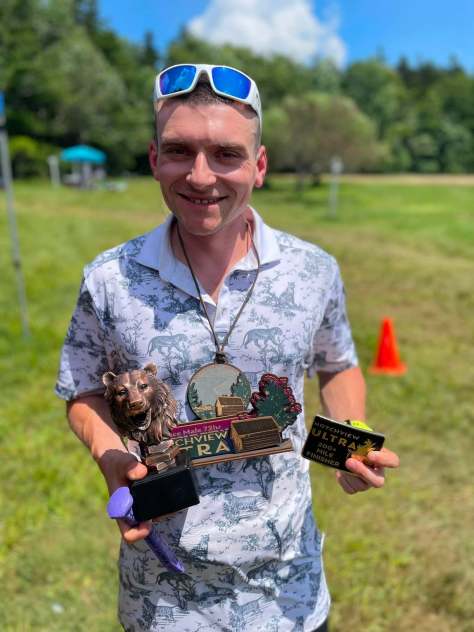
Niebla’s challenges weren’t done once his foot allowed him to continue, but volunteers and fellow runners gave him additional boosts of support and positivity when he needed them.
“The one memory that really stuck out was experiencing my first puke and rally,” Niebla said. “There were some other runners who saw I was struggling to hold it down, and they offered to get something for me at the aid station. I was astounded when I crossed over the Start/Finish line to see a runner standing there in the hot sun with a cold can of ginger ale, all just for me.”
Ultimately, Niebla pushed hard through his final laps and crossed the finish line for the final time after 71 hours, 58 minutes and 50 seconds with a new course record of 258.4 miles completed.
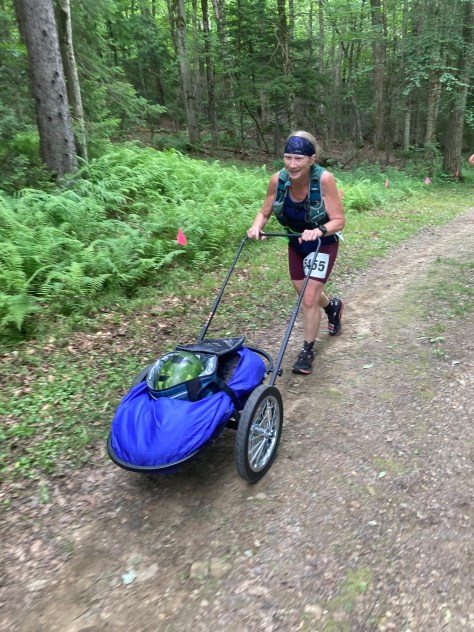
Niebla’s grit exemplified that of many of the 84 runners who took part in the 72-hour race. Fifty-eight of them completed at least 53 laps and 100.7 miles, and five of them completed at least 106 laps and surpassed the 200-mile mark. In addition to Niebla, Michael Martinez also went well over the 200-mile mark, completing 235.6 miles in his third appearance at Notchview. In 2024, Martinez, 47, of Manchester, N.H., completed 191.9 miles, and then he returned in 2022 and finished as the runner-up in the 100.7-mile race. This year, his massive effort was the third-best in event history. Third-place finisher Michael Lo Presti surpassed the 200-mile mark for the second straight year. After logging 216.6 miles in 2025, the 55-year-old from Norfolk, Conn., completed 210.9 miles this year. Fourth-place finisher Shane McNally also surpassed the 200-mile mark for the second time in a row. McNally completed 201.4 miles in 2025, and the 46-year-old resident of Everett, Mass., went one loop further this time to finish with 203.3 miles. Fifth-place finisher Ryan Danby, 33, of Providence, R.I., broke the 200-mile mark for the first time with a 201.4-mile effort.
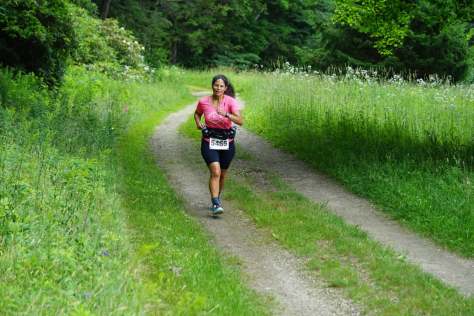
In the female field, 51-year-old Deborah Peak of Franklin, Mass., had a big weekend that concluded in a familiar place. Peak won the 72-hour race in 2024 with 169.1 miles. This year, she was victorious with a new personal best of 178.6 miles. She needed every bit of effort to win because she had to fend off two Notchview regulars and former champions. Jessie Makela, 42, of Stafford Springs, Conn., was the runner-up just one lap behind Peak with 176.7 miles, and 66-year-old Ann Alessandrini of Johnsonville, N.Y., was third with 161.5 miles.
Similar to the 72-hour race, the 28 runners in the 48-hour race also battled through ups and downs over multiple days and the frontrunners pushed hard on their way to posting big results. Top men David Stawski, 44, of Manchester, Conn., and Matthew Ford, 25, of Clarks Summit, Pa., dueled closely throughout the weekend and both surpassed the course record, but Stawski earned the win by two loops with 159.6 miles, followed by Ford with 155.8 miles. In the women’s field, 50-year-old Notchview regular Rebecca Burke also eclipsed the course record and won with her 134.9-mile effort. Trishul Cherns, 69, of Kingston, N.Y., was the third-place male and fourth overall finisher with 129.2 miles, while Burke was joined on the female podium by Jennifer Bell, 60, of Dalton, Mass., and Nicolle Quinn, 51, of Beverly, Mass., with 112.1 miles and 106.4 miles apiece.
Most of the 27 runners who completed the 100.7-mile race needed well over a day to finish–just two runners needed less than 24 hours and just eight finished in under 30 hours–and several had to overcome a rollercoaster of ups and downs to earn their belt buckles. John Kemp was no exception. The 58-year-old from Sheffield, Mass., has been a regular presence at BURCS races for years as both a runner and volunteer, including volunteering at Notchview in 2025, but he toed the Notchview starting line for the first time this year in hopes of completing his first 100-miler since contracting Lyme Disease in 2019. Kemp admitted his weekly mileage has been minimal in recent years, limited to around 15 miles per week of running and walking with his dog, Lucy, along with a 15- to 20-mile long run on the weekend. Still, with successful finishes of the Grindstone 100 in 2017 and The Great New York Running Exposition 100-miler in 2019, Kemp planned to tap into his ultra experience to effectively manage the race.
“I am consistent, but that’s it – nothing special or extreme,” he explained. “Perhaps I am simply riding on the previous decades of harder training since I’ve been running ultras for 15 years now?”
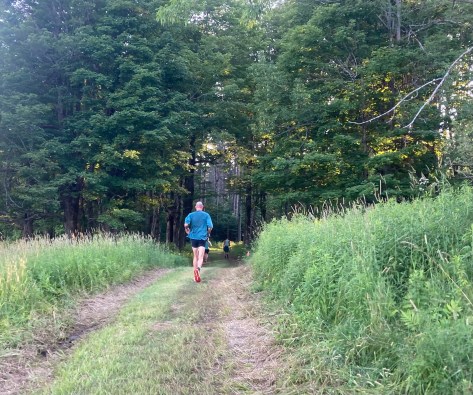
Kemp ran relaxed from the start, walking all of the uphills and gliding along the flats and downhills, looking effortless at times. His splits were largely consistent for the first 12 1/2 hours as he hit the 100K mark. His pace slowed a bit from there, but he continued to lead the entire 100-mile field. That continued past mile 80 before Kemp’s race derailed. Kemp completed his 45th lap just after sunrise, reaching 85.5 miles, and then made a quick pit stop that left him concerned that his body was in trouble. His urine was as dark as the Coke he’d been drinking all night. He’d ingested plenty of caffeine, but hadn’t replaced his electrolytes. Kemp completed one more lap, reaching 87.4 miles, and then told race director Benn Griffin that he planned to drop to avoid doing any damage.
“Benn tried to talk me out of it… and succeeded in getting me to go lie down, drink and eat and generally take a break before deciding whether I should really drop,” Kemp recalled. “I don’t know how long I laid down – maybe 30 minutes? Jay (Durand), Benn and Marie (Gryszowka) came over to check on me, and Jay said he’d come out with me for a ‘bandit lap’ if I got up and got going again. So I did. Jay said to me after that second lap ‘if you do one more lap you can take another break, and then you only have 3 more laps!’ I basically just followed his advice.”
By following that guidance, Kemp went from DNF to finisher.
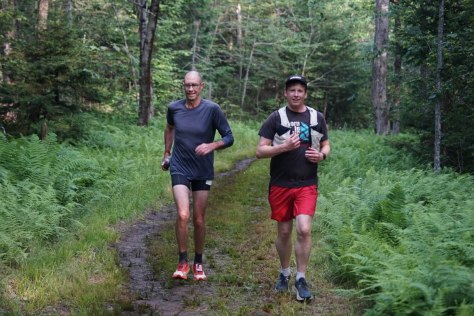
“‘Finding a way to keep going’ was really about listening to my friends, and letting them convince me to keep going like they said I should!” Kemp said. “Jay, Benn and Marie were key in getting me going again. And in particular, chatting with Jay while he checked up on me, gave me what I needed to get it done. The support was the crucial element that led me to finish safely. I know it’s easy to say ‘oh, all they did was talk to me,’ but the reality is if I’d been there actually alone, I would have just stopped. Without those people I wouldn’t have finished. In hindsight, it’s a reminder that when done right, ultra-running is a team sport. And provides community as much as it does competition. Notchview is all about community, which makes it special.”
Despite the slower final laps, which included walking backwards at times to relieve a painful right calf, Kemp crossed the finish line of his 53rd and final lap as the second overall finisher and first-place male in 22:17:31. His time was the fifth-fastest ever on the male record board.
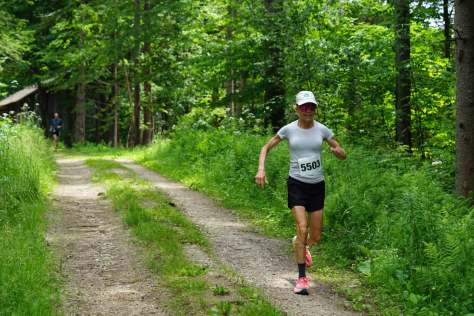
Unlike Kemp, female champion and overall winner Katy Kelly made the miles look easy. The 58-year-old from Dorchester, Mass., played professional basketball in Ireland in the 1990s and has parlayed her athleticism into ultramarathon success in recent years, including victories at the Wildcat Ridge Romp 100K in New Jersey in 2021, the GAC Fat Ass 50K in 2023, the Viaduct Trail 100-miler in Pennsylvania in 2023, and the Chesterfield Gorge Ultra 100-miler in 2024. She and Kemp were rarely separated by more than a mile or two for the majority of the race, but Kelly moved to the front during the final quarter of the race on her way to securing the overall victory and her first 100-mile finish at Notchview, winning and setting both a female course record and personal best with her time of 21:44:00.
Kelly was joined on the female podium by runner-up Miranda Gajda, 32, of East Chatham, N.Y., and Tek Ung, 44, of Cranston, R.I., who followed in 28:18:34 and 29:02:08, respectively. Kemp was joined on the male podium by Robert Alves, 47, of Groton, Conn., and Joe Spinazola, 33, of East Chatham, N.Y., who were separated by just 12 minutes, Alves finishing in 26:21:25 and Spinazola in 26:33:57.
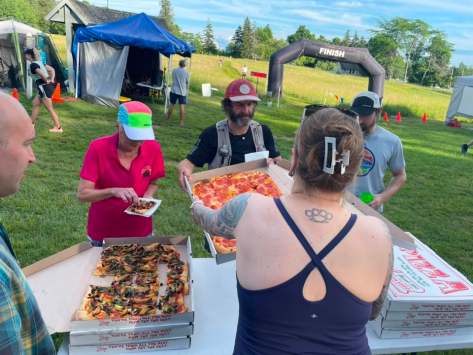
Not everybody at Notchview ran for days on end. Some ran for a full day or less, but still mustered plenty of miles while bringing fresh energy to the loop alongside the multi-day runners. In the 24-hour race, that included 28-year-old Lynnsey Martin of Cambridge, Mass., who defended her title and won the race outright with 95 miles. Martin’s effort led the way for a female field that secured the top six overall places, including runner-up Claire Davenport, 46, of New York, N.Y. (83.6 miles) and third-place Renee Butler, 49, of Worthington, Mass. (77.9 miles). Chris Butler, 51, also of Worthington, led the men’s 24-hour field with 53.2 miles, followed by 43-year-old Robert Southworth of Londonderry, N.H. (51. miles), and 54-year-old Craig Wallace of Marlborough, Conn. (47.5 miles).
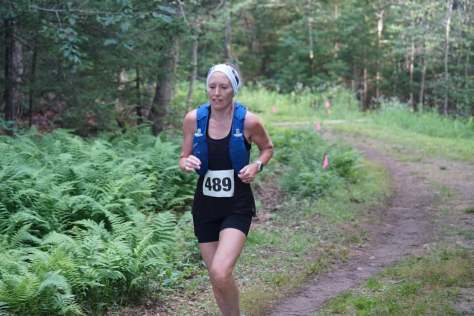
In the 12-hour daytime race, 47-year-old Mari Engelhardt repeated as champion with 62.7 miles, topping the overall field with the second-best effort in course history. Anne Marie Winchester, 59, of Duxbury, Mass., and Cheryl Crawford, 59, of Kington, Mass., joined her on the female podium with 55.1 and 49.4 miles apiece. Charlie Gundlach, 39, of Eagle, Colo., led the male field with 57 miles, followed by Luis Gonzalez III, 38, of Cranston, R.I., and Zack Sullivan, 34, of Pawtucket, R.I., with 51.3 and 43.7 miles apiece. Donovan Snyder, 31, of Dalton, Mass., was the top nonbinary performer with 39.9 miles.
In the 6-hour race, 41-year-old Matt Pacheco of Springfield, Mass., followed up his course record-setting effort in the 12-hour race last year by smashing the 6-hour mark this year, winning with 41.8 miles. Runner-up Alexander Burke, 30, of Dedham, Mass., also broke the previous record with 39.9 miles, while 36-year-old Daniel Wheeler of Lanesborough, Mass., was third with 30.4 miles. Top female Sarah Brenner, 30, of Cambridge, Mass., won with 32.3 miles, missing the course record by one lap. Emily Holman, 48, of Cambridge, Mass., and Sheila Wilson, 46, of Acworth, N.H., were second and third with 28.5 miles apiece.
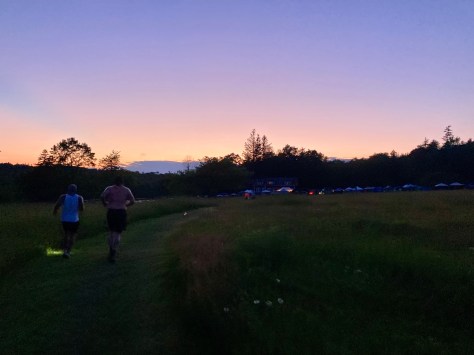
In addition to those distances, the event featured a new offering: a second 12-hour race that took place overnight between Saturday evening and Sunday morning. Several familiar faces opted for this new Notchview experience, including a few–like Jay Durand, Amanda Cabrera and Rebecca Gonzalez-Kreisberg–who volunteered before running. Judy Proteau has completed 100 miles or more at Notchview three times, including 163.4 miles in the 2025 72-hour race. She completed the Chesterfield Gorge Ultra 100-miler in late May, so she opted for the night race at Notchview this year and savored the opportunity to experience the event in a new way.
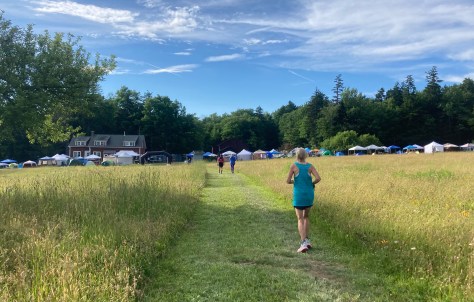
“The idea of missing out on a fun weekend of camaraderie and miles made me sign up for the only option that was left,” she said. “I really liked the thought of ‘survive the night, see the light and you’re done with the fight.’ I loved starting the race during the daylight and seeing all my friends on the trail. As I ran through the night it was cool and dark. I heard fireworks in the distance and could hear owls in the woods. It was magical when the sky started to lighten and the sun started to rise. At that point I only had a few more hours of running and it was very motivating.”
While piling up miles by headlamp, Proteau made a point of spreading cheer to the other runners on the trail. She’d been in their position before in prior years, and offered words of encouragement as she passed by.
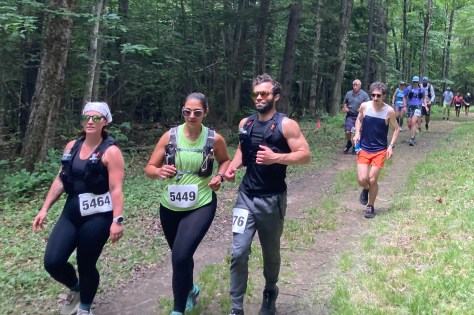
“It gives me joy to see people persevere over tough miles, and if there is anything that I can do to lighten their mood for just a couple of minutes I want to do that,” she said. “There can be a bit of an emotional roller coaster over 100 miles, and having someone say that you’re doing great and looking strong helps a lot. It goes back to the caring community that Benn has fostered.”
Ultimately, Proteau was the top finisher in the female field and the 52-year-old from Marlborough, Mass., set the inaugural female course record for the 12-hour night race with 45.6 miles. Another Notchview veteran, 42-year-old Keith Bourassa of Keene, N.H., set the male record with 64.6 miles. Eric Rice, 42, of Worthington, Mass., and Michael Rios, 38, of Lowell, Mass., joined Bourassa on the male podium with 62.7 and 51.3 miles, respectively, while Proteau was joined by Jillian Ellefson, 46, of Vernon, Ct., and Amanda Cabrera, 40, of Brookline, N.H., who each completed 36.1 miles.
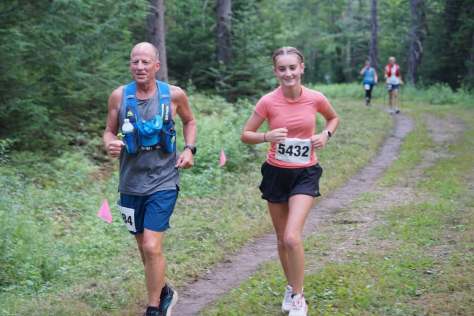
Beyond the course record-setting performances, victories and podium finishes, runners found sources of motivation and inspiration in a variety of places. They saw it in the grandfather/granddaughter duo of Stephen Westbrook, 63, and Abigail Gilley, 15, of North Waterboro, Maine, who completed 102.6 miles together, earning their third Notchview buckles. They saw it in Stephen’s wife, Kelley Westbrook, who stood by the finish line for nearly the entire duration of the event, cheering every runner each time they passed through. They found it in Jen Styer, 36, of Lebanon, Pa., who long dreamed of running 100 miles, but had those dreams derailed by a multiple sclerosis (MS) diagnosis … until this year when she managed both the miles and the MS symptoms to complete 100.7 miles in the 72-hour race. They saw it in John Kinnear, 59, of Manchester, N.Y., who completed 100 miles at Notchview on his fourth try. And they saw it in Notchview regular Eugene Bruckert who, at 91 years young, once again made the trip from his home in Arlington Heights, Ill., to take on the 72-hour race and finished with 68.4 miles.
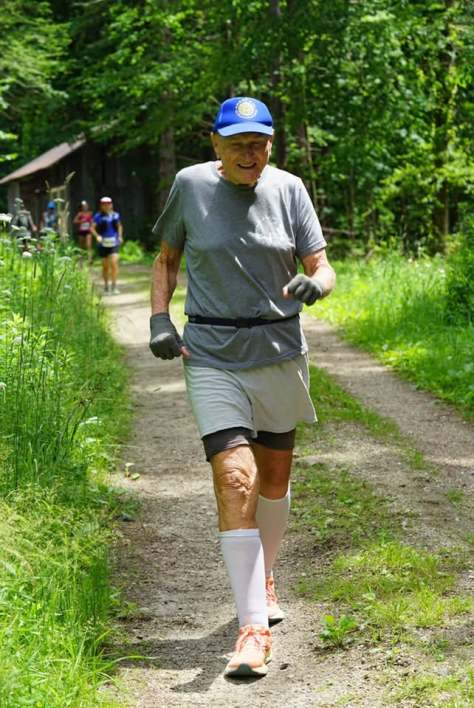
The runners also saw inspiration all around them as they circled the Notchview loop time after time, day and night, surrounded by the beauty of the Berkshires.
“[I’ll remember] what it means to be part of the ultra community,” Kemp said of his lasting memories of the weekend. “The views of Notchview when it was getting dark in the evening, light in the morning. One of the benefits of that loop is that you get to see the magic of this amazing place we live, here in the Berkshires. Just before it got really dark, you could see these wispy clouds and the stars in the sky, looking out over the southern Berkshire hills. Someone had stopped to take a photo at the bottom of the grassy bit, and I looked up to see what she was seeing, and got this sense of peace and belonging in the universe. How amazing is it to be out there on a trail all day and night, and to really experience the changes in yourself and that piece of land? And then, there is that part, back on the grass towards the end of the loop, when at night, I could see all the lights, clearer in the pitch dark, and know that soon, after feeling alone and quiet, hidden in the forest and the night, there was this warm and welcoming place to come back to every two miles.”
Raffle Raises Money for Conley Family: Longtime New England trail- and ultrarunning volunteers and race directors Bill and Darby Conley and their family recently lost their home to a fire during the Fourth of July weekend. They organize popular events such as The Hamsterwheel and the Manchester 2 Monadnock Ultramarathon in New Hampshire. The BURCS organized a raffle at Notchview and raised $759 to benefit the Conley family.
Up Next in the BURCS Race Series: The BURCS Race Series rolls on with the 14th annual Sweltering Summer 8-Hour on Saturday, Aug. 8, at Clapp Park in Pittsfield, Mass. The starting time has been moved forward one hour to 8 a.m. Following Sweltering Summer, the series continues on Aug. 22 with the 11th annual Jug End Loop Ultra and 4.2-mile race in Egremont, Mass., followed by the 11th annual Free to Run Trail Races on Sept. 12 at Pittsfield State Forest in Pittsfield, Mass.