
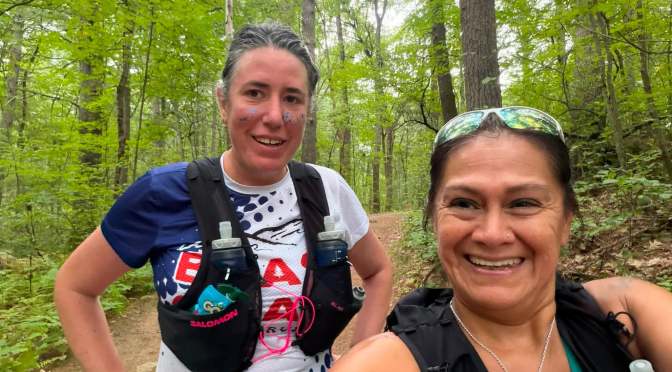
Rebecca Gonzalez-Kreisberg is no stranger to running ultramarathons. She has completed at least a dozen ultras, including a personal-best 102.6-mile performance at the Notchview Ultra 72-hour race in 2023. So when Gonzalez-Kreisberg showed up to the Trail Animals Running Club’s TARC Fall Classic to run the event’s 50K race on Saturday, Sept. 5, the 36-year-old from Amherst, Mass., was confident her legs could handle the distance on the rolling trails of Great Brook Farm State Park in Carlisle, Mass. The bigger challenge for her would be handling the crowded trails as other runners zipped past in some of the event’s other distances, which included a 50-miler, 20-miler, half marathon, 10K, and kids’ fun run. In total, more than 600 runners took part in the event, making it the largest TARC event in club history.
Gonzalez-Kreisberg has moderate-high frequency unilateral hearing loss, a condition she has had since she was 8 months old. Though she has worn a hearing aid since age 4, she doesn’t wear it while running to protect the device from being damaged by sweat or weather. As a hearing-impaired athlete, Gonzalez-Kreisberg has difficulty hearing what direction a sound is coming from or detecting others when they approach from behind. She can be easily startled, so she must be extra attentive with her senses on high alert while running, something that becomes exhausting mentally even when her legs still have plenty to give.

Rather than dealing with the stresses of racing, Gonzalez-Kreisberg spends the majority of her time volunteering to support others as they pursue their goals. She is one of New England’s most prolific volunteers, regularly giving more than 100 hours per year in service to the community’s events, and in 2024 she volunteered for more than 200 hours at trail races. Recently, she has been feeling the itch to race and push her limits, and she has been dreaming big.
“After taking most of the last three years off from running, I leapt back in in May with a technical 25K and again in June with an almost as technical 30K, before deciding to run a 100K next July, with auditory guides,” she explained. “With that decision, I realized I need more experience with fixed-distance racing, versus my typical time-based races like Notchview.”
The 25K came at Drummer Hill in Keene, N.H., and the 30K was at the Edge Hill Trail Race in Ashfield, Mass. Both went well, setting her up to tackle the 50K at the TARC Fall Classic.
It was around 60 degrees, cloudy and humid when Gonzalez-Kreisberg arrived at the Fall Classic starting line. She had a small “hearing impaired” sign affixed to the back of her pack, but otherwise blended right in with the other 180-plus smiling, anxious runners who were prepared to tackle the ultra distance options. Another 400-plus runners in the sub-ultra distances would join them on the approximately 10-mile loop course two hours later.
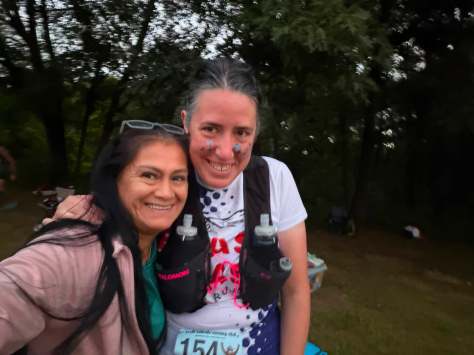
A friend and frequent volunteer, Daria Cunningham, found Gonzalez-Kreisberg in the crowd and wished her luck. Cunningham has spent the past year recovering from a femoral neck stress fracture in her hip and has gradually increased mileage during the past few months. She signed up for the 20-mile race at the Fall Classic, seeking to get some quality time on her feet while supporting other friends along the course. Cunningham snapped a selfie with Gonzalez-Kreisberg, and then stepped to the sideline to cheer for runners at the start before getting ready for her own race.
Gonzalez-Kreisberg’s race started off well. The ultrarunners spread out within the first few miles, so she settled into a comfortable pace and didn’t have to worry about people flying past her. That changed near the end of the loop.
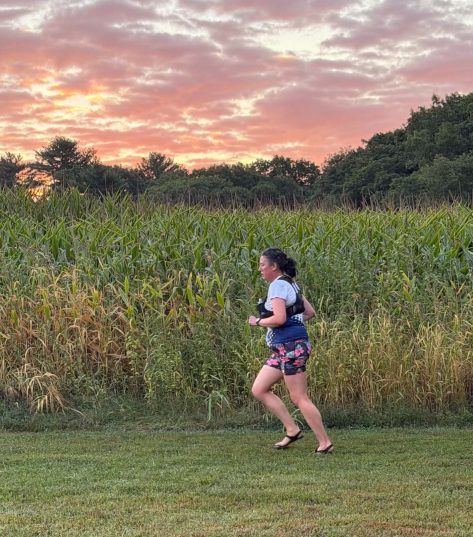
“I had a strong start for much of my first loop, but after about 8 miles my race met up with the 10K and half marathon runners who were going much faster,” she said. “Much of that section of the course is single track and runners were flying by me without much of a heads up, sometimes even from both sides. It ended up sending me into a panic attack that I couldn’t escape because runners kept coming. This was a challenge no one could have expected I’d have, but it definitely took a toll.”
She completed the loop, took a seat in her chair, shed a few tears and settled down. After composing herself, she grabbed some snacks from the aid station and began her second loop.
“By this point, I had started to slow down some but was determined to keep moving and run the flats and downhills,” she said.
Gonzalez-Kreisberg continued onward. The 10K was done so there were fewer runners blasting past her at high speeds, but there were still plenty others to encounter in the remaining miles with hundreds of runners on the course. Though her legs were still going strong, her mind was exhausted. Thankfully, some mental relief was just ahead.
When Gonzalez-Kreisberg arrived at the aid station around mile 18, she encountered a friendly face. Cunningham was there, about 14 miles into her 20-mile run.
“So when I encountered Daria, she asked how I was doing. And I told her, honestly,” Gonzalez-Kreisberg said.
“She explained how hard it was not being able to hear as people passed; that the one-lane trail and the number of people that also were on the course made it very difficult for her alone,” Cunningham recalled.
Up to that point, Cunningham had been running with a friend, chatting and chipping away the miles at around a 15-minute pace. Her run was going according to plan. As she listened to Gonzalez-Kriesberg, Cunningham decided the plan needed to change.
“Rebecca voiced her concerns and how hard it was for her,” Cunningham recalled. “I offered to run the rest [of my race] and catch up first, thinking maybe that could help. My friend offered to walk with her, too. That’s when I really realized she needed help then. Not later, but at that point she needed the help of my ears and support of a friend.”
Cunningham decided to DNF the 20-miler, and instead complete more miles and have a much more meaningful race day experience.
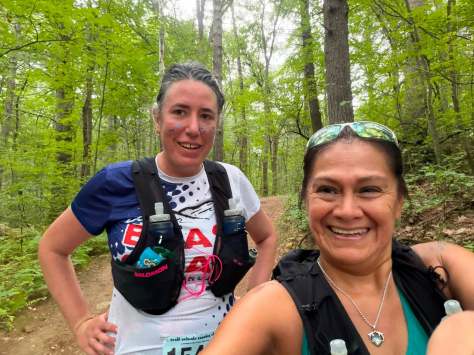
“Daria already knew of my plans to do my 100K next year with guides so she decided to change her race and join me,” Gonzalez-Kreisberg said, adding that Cunningham might be one of her guides for the 100K.
It was a learning process for both Cunningham and Gonzalez-Kreisberg, but they made a good team. Cunningham served as Gonzalez-Kreisberg’s ears for the remaining miles, alleviating a stressful burden so Gonzalez-Kreisberg could focus on running.
“Rebecca made it clear this is new to her, and it was a learning process of what was needed by me,” Cunningham explained. “To start, it was me letting her know when someone was behind us and when they were passing. I was happy to help in any way she needed.”
The teamwork paid off and transformed Gonzalez-Kreisberg’s day.
“It made a significant difference for me,” she said. “I’ve known for a while that my hearing loss leads to more constant stress and anxiety, especially while running, to keep up with hearing where others are. I’m checking more if I’m by myself, and if I don’t, then I’m being startled every time.”
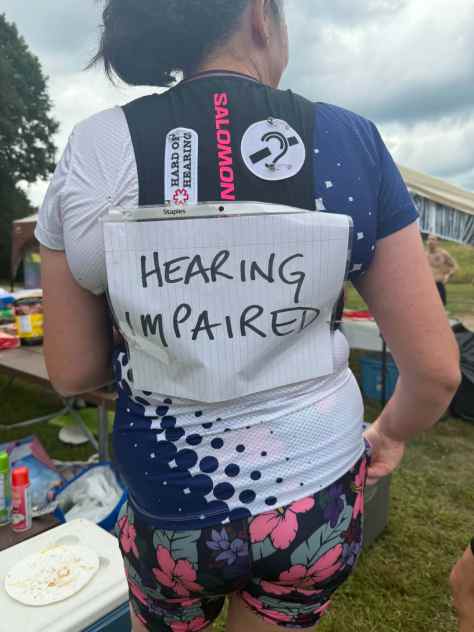
At the end of the second loop, Gonzalez-Kreisberg spoke to Race Director Patrick Caron, who helped find materials to make a larger “hearing impaired” sign for Gonzalez-Kreisberg’s pack and quickly approved allowing Cunningham to be a pacer.
The women departed on loop three, and together made their way through the course in good time.
“Throughout loop three, Daria took the lead most of the time but was regularly checking around and was always well ahead in notifying me when a runner was coming,” Gonzalez-Kreisberg said. “I slowed down more through that final lap but was determined to finish.”
That determination concluded with a spirited sprint to the finish line.
“I still sprinted to the finish line, and I loved that I was able to,” Gonzalez-Kreisberg said. “I wasn’t expecting the race to end up centering on my hearing loss, but it did. In the end, it meant a lot to be able to learn more about myself as a hearing-impaired runner. I started talking about needing auditory guides at some races over a year ago, and to not only experience another concrete reason why I would need it but to be able to try having a guide with a friend for the first time felt valuable. The race also means I get to continue to help educate my ultra community about running with hearing loss.”
The result was meaningful for Cunningham, too. Though the official results say she DNFd the 20-miler, she accomplished so much more. She enjoyed a 28-mile day on the trails and supported a friend in overcoming challenges to achieve a memorable goal.
“I’ve had a few DNFs, of which were me not being prepared enough but still showing up to try. What I’ve learned is every DNF you learn and take something from it,” Cunningham said. “This DNF was completely different. What I took from this was friendship is more than a finish or a medal. I am proud of this DNF, and I would do it all over again.
“Rebecca amazes me with her strength and how she helps others as well. I’ve watched her offer in the middle of the night at Notchview to keep people company if they needed it. Her kindness in helping others, crewing, encouraging and cheering runners on, and all the hours she spends volunteering at so many races is amazing. It’s nice to give back to someone who gives so much to others.”
Gonzalez-Kreisberg is already looking forward to teaming up with Cunningham at another TARC race in the near future. Both are signed up for the TARCkey Trot 6-Hour Ultra in November and plan to share some miles on the 3.5-mile loop course.
Morris, Souza Top 50K Field
Thanks to Cunningham’s assistance, Gonzalez-Kreisberg was one of 102 runners who completed the Fall Classic 50K race out of 120 who started. Mitch Morris, 29, ran away from the field and won comfortably in 3:59:51. He was joined on the male podium by 22-year-old Zachary Thomas and 28-year-old Ryan Pfenning who followed in 4:22:09 and 4:30:24, respectively. Jon Hunter, 35, and Neil Martin, 49, followed and crossed the finish line together in 4:55:27. In the female field, 45-year-old Nicole Souza took the top spot in 5:25:57. The win came two months after winning the 12 Hours at Lawrence Woods race at the Middlesex Fells Reservation in Medford. Souza was followed by 27-year-old Olivia Siegel in 5:51:39, and third-place Madeleine Snyder, 31, in 6:07:49. Moments later, 38-year-old Jessica Houtz and 31-year-old Patricia Swierk completed the top five in 6:08:29 and 6:08:38, respectively.
Record Number of Finishers in Fall Classic 50-Miler
In the event’s longest distance offering–the five-loop 50-miler–63 runners started the race and a record 38 finished within the 13-hour time limit. That was 10 more than the previous record of 28 which was set at the 2018 event. A familiar face was out at the front as 43-year-old Mark Howard improved upon his third-place finish in 2025 by winning this year’s race in 8:39:54. Howard’s performance was more than 90 minutes faster this year. Runner-up Tyler Wasson 42, followed in 8:43:41, improving upon his seventh-place effort in 2024. Brendan Walsh, 25, completed the male podium in 8:56:28, followed shortly after by 21-year-old Shikhar Singh and 42-year-old Danh Nguyn in 9:01:56 and 9:02:49, respectively. It was Singh’s first ultramarathon finish, and just the latest in a busy year of ultrarunning for Nguyen. He opened the year by finishing fourth at the “Don’t Run Boston” 50-miler and fifth at the TARC Spring Classic 50K in April, and then finished third at the Chesterfield Gorge Ultra 100-miler in late May. After a few months of recovery time, Nguyen bounced back with a strong run at the Fall Classic.
Meanwhile, the 50-mile female field had several strong performers, too. Eva Brydson hadn’t raced an ultra since winning the Big Brad Ultras 50-miler in Maine last fall, but the 29-year-old returned to the starting line at the Fall Classic and earned a victory in 9:17:16. Duong Thi Nguyen, 36, was the runner-up in 10:38:48, earning her second TARC podium finish of the year. She placed third at the TARC Summer Classic 40-miler in August. Summer Classic 40-mile champion Jacqueline Scanlon, 29, completed the podium at the Fall Classic in 11:28:53. Kerrie-Ann Briguglio, 55, and Jocelyn Cascio, 51, were a very close fourth and fifth as they finished together in 11:29:54.
Strong Performances Aplenty in Sub-Ultra Distance Races
More than 400 of the Fall Classic runners took part in the sub-ultra distance races, and several turned in speedy performances. Seventy-seven runners completed the two-loop 20-mile race, and 23-year-old Jonah Jaffe blitzed to the overall win in 2:28:51, winning by seven minutes. Brian Belley, 39, was second in 2:35:41. First-place female Gillian Oaks, 26, followed in third place overall in 3:00:32, just a few strides ahead of third-place male Maxwell Christopher, 25, who finished in 3:00:40. Oaks was joined on the female podium by 49-year-old Jennifer Corbett and 44-year-old Jade Badger who followed in 3:03:18 and 3:22:28, respectively. Blox Bloxham, 32, topped the nonbinary field in 5:41:59.
An additional 136 runners completed the half marathon, with 41-year-old Timothy Cronin fending off 35-year-old Adam Ribeiro and 34-year-old Seabiscuit Horseman to top the male field. Cronin won in 1:29:22, followed by Ribeiro in 1:31:40 and Horseman in 1:31:45. Breanna Glasgow, 39, was the first-place female finisher by a 5-minute margin in 1:52:35. Victoria Loehle, 30, was second in 1:57:27, followed by 29-year-old Nicole Geardin in 2:02:52. Eli Markworth set the only course record of the day as the 27-year-old established a nonbinary division course record in 2:10:18. Rin Xie, 26, was the nonbinary runner-up in 2:25:59.
The 10K race had the largest field of finishers with 188 runners completing the course. Jefferson Do Carmo, 18, led all runners in 44:12, followed by 14-year-old Ryan Ferguson in 45:40 and 29-year-old Daniel Gorelik in 45:53. Female champion Lena Morris, 19, was next in 46:47. She was joined on the female podium by 39-year-old Michelle Boland and 36-year-old Kate Warwick. Boland finished in 49:27 and Warwick in 50:36.
Up Next In the TARC Trail Series: The TARC Trail Series has three events remaining on the 2026 calendar. Up next is the TARC Stone Cat Trail Festival on Saturday, Nov. 7, in Ipswich, Mass. Runners will take on 100K, 50-mile, marathon, half marathon and 10K races. There will also be a Cider Donut Mile and free youth fun run. From there, The Trail Animals head to Winchester, Mass., for the TARCkey Trot 6-Hour on Saturday, Nov. 14, at Wright-Locke Farm and Whipple Hill. They then close out the season with the TARC Winter Classic on Saturday, Dec. 5, at the Middlesex Fells Reservation in Stoneham, Mass.

