
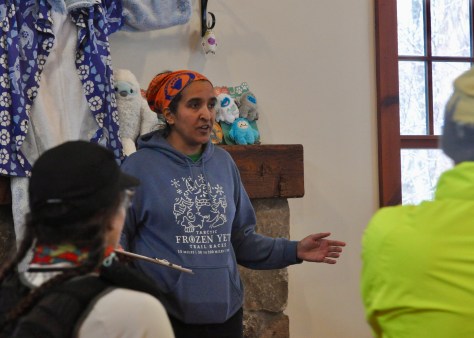
WESTWOOD, Mass. – Seventy-five runners gathered inside Powissett Lodge as a light snow fell outside. Some topped off water bottles and soft flasks, while others rustled through their packs, double-checking to make sure they had everything they needed. Most listened intently as co-Race Director Surjeet Paintal gave the pre-race briefing.
They were wise to pay attention, because the seventh running of the Trail Animals Running Club’s TARCtic Frozen Yeti 30-Hour Ultra on Feb. 7-8 at Hale Education would be unlike any prior edition.
The Frozen Yeti has had years with snow, including the 2022 edition that was postponed by a week after nearly two feet of snow fell at Hale beginning the day before the race, making it impossible for emergency vehicles to gain access if needed. The Frozen Yeti has had extremely cold years, none more so than the 2023 edition when it was -9 degrees Fahrenheit with a wind chill of -28 at the start of the race, though it steadily warmed throughout the event, ultimately with a 55-degree swing by its conclusion.
The 2026 edition looked to be a combination of the two. Twenty-two inches of snow fell at Hale two weeks prior to race day, and most of it remained thanks to temperatures that had stayed stubbornly below freezing, minimizing any melt. Attempts had been made to pack it down along the course, but that mostly meant that runners might sink a couple inches less while post-holing through the sticky mashed potato-like snow. Additional snow began to fall a few hours prior to race day, and it would continue for much of the race’s first eight hours.
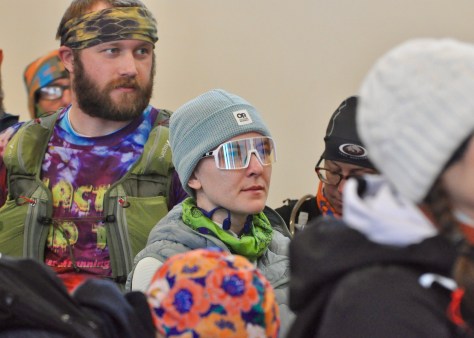
The snow would be a nuisance, but the real concern was cold. Unlike 2023 when it started bitterly cold but warmed as the race progressed, this year was projected to be the opposite. It was a relatively pleasant 22 degrees outside as Paintal gave the pre-race briefing, but was forecast to drop to the low single digits overnight with a wind chill of -15, creating potentially dangerous conditions for fatigued and nutritionally depleted runners.
Paintal told runners that she and fellow RDs Carolyn Shreck and Josh Katzman would keep an eye on them and possibly force runners to stop if they had any concerns about individual safety, but she concluded the briefing by reminding runners to take care of each other, too.
“Be patient! Be kind to your friends. If you see somebody struggling, make a new friend,” Paintal said. “This race is able to continue through all sorts of conditions because you all take care of each other. If something goes sideways, we don’t want that to happen. Part of this race is you guys running; part of this race is also you guys taking care of each other. We’re all here to have fun and be insane.”
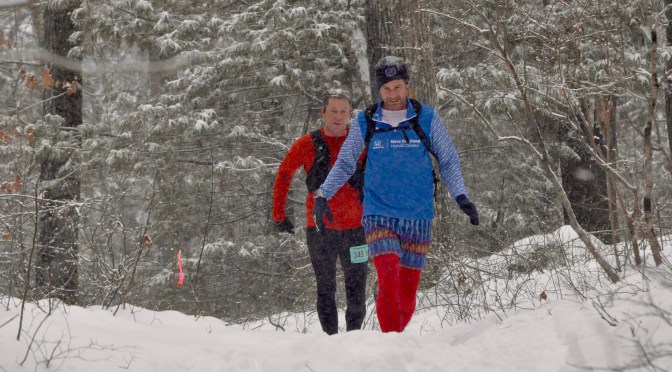
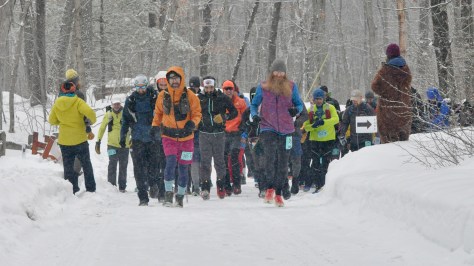
With that, the runners departed the warm lodge and into the snowy cold. For most, the fun and insanity was short-lived due to the extremely difficult footing and constant post-holing as they made their way through the three five-mile mini-loops that make up the course, each starting and ending back at Powissett Lodge.
The race began with the slowest first five-mile loop in Frozen Yeti history. Most of the snow was sticky and the footing semi-firm. If runners shifted too far to either side of the trail, they sank into knee-deep powder.
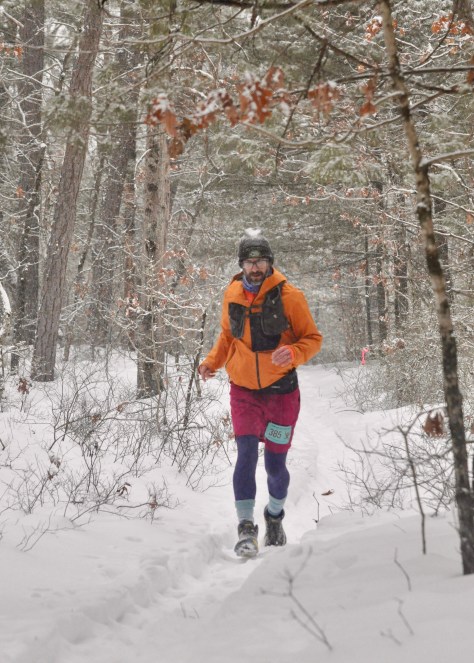
“Tough,” was how early leader Matt Pacheco described the conditions as she plowed his way through the first mini-loop.
“It’s slow-going,” added James Menousek while struggling to stay upright on a slippery downhill.
Even Frozen Yeti veterans weren’t immune from the challenges. Jason Kaplan, who completed 100 miles at the 2024 race and 110 in 2025, was uncertain how his race would play out.
“I don’t know how long I’m going to last in these conditions,” Kaplan admitted as he neared the end of his first mini-loop.
Many runners voiced relief during the brief moments when they popped out on the park road that had been plowed to a mostly smooth, snowy glaze, and found friendly footing to run. For most, it was the best running they’d enjoy all weekend.
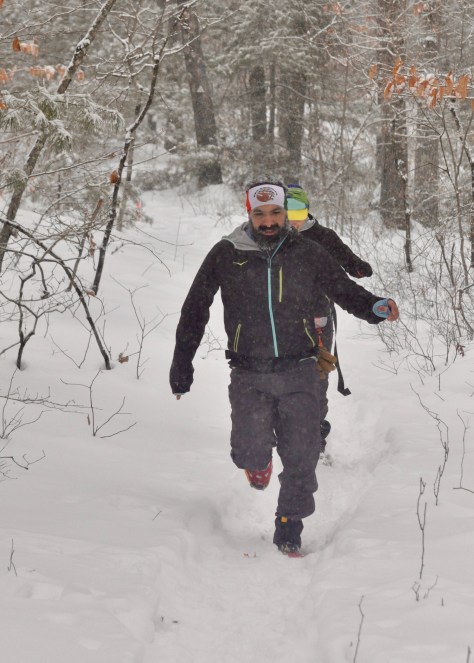
“That was wild!” exclaimed Liv Colombo as she trotted down the park road toward Powissett Lodge at the end of an early loop, shaking her head at what she and her fellow runners had just encountered.
For about a half-dozen runners, the first mini-loop was enough to call it a day. A few more stopped at the 10- and 15-mile marks. Some ventured out for a second pass through the clover-leaf course, but each additional mini-loop saw more runners withdraw.
While the footing was the biggest challenge during the early hours, the weather increasingly became an obstacle. The temperature stayed steady throughout the day, but the snowfall increased in intensity and the wind gradually picked up as the hours passed, dropping the wind chill to just 10 degrees by early afternoon.
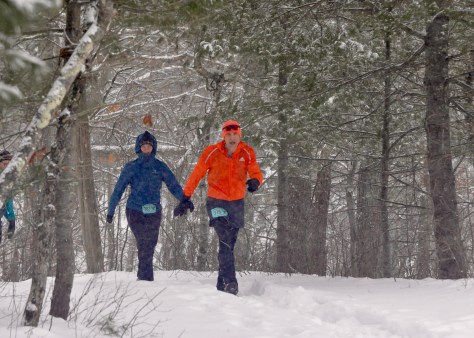
The snow subsided around 4 p.m., but the temperature plummeted from there – as did the number of runners still on the course. For safety reasons, two of the three mini-loops were closed so all runners would be confined to the same area during the overnight hours. Around a dozen runners continued through the night, and they enjoyed extended breaks to warm in the lodge as the temperature dropped to 0 degrees with a -15 wind chill.
Sunday morning brought little reprieve, save for the sun. The temperature stayed in the single digits with 13-mile-per-hour winds and the wind chill well below zero as the final handful of runners continued onward. Despite his early doubts, Kaplan was still among them. He was joined by Geoffrey Howe, Denise Klatt, Gumi Mabvuta, Brian Haley, Mike Martineau, Max Taylor, Chris Manwaring and Andrew Novis who continued to battle the frigid temperatures and the now well-churned snow.
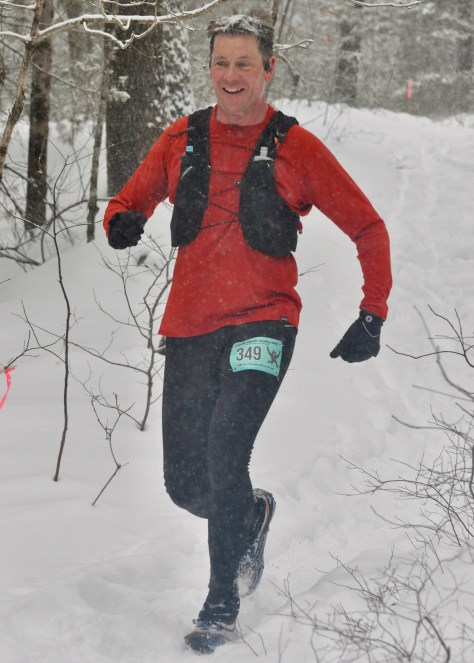
For the first time in Frozen Yeti history no runners reached the 100-mile mark. Howe and Kaplan led all runners with 75 miles apiece, Howe doing so in 27:52 to earn first place overall and Kaplan in 29:06. Klatt finished third overall and was the first-place female finisher with 70 miles in 28:43. Manwaring was fourth overall with 65 miles, followed by Taylor with 60. Jerry Audet and Jason Geroux each completed 55 miles, while Bryon Nelson, Haley, Martineau and Mabvuta each completed 50 miles. Colombo was 15th overall and the top nonbinary finisher with 35 miles.
Only 33 runners – just 44 percent of the starting field – completed at least 30 miles for ultramarathon finishes. That was the fewest ultra finishers in Frozen Yeti history. The event also includes a 15-mile night race, and it too had its fewest finishers this year with just 15 runners completing the race. Chris Oriel topped the male field in 3:12:22 while Jillian Rocco led the female field in 4:10:12.
Up Next in the TARC Trail Series: The 2026 TARC Trail Series will continue with its second race of the season on Saturday, March 21, when the Trail Animals return to Hale Education for the To Hale and Back 6-Hour Ultra and 3.5-mile race. After that, TARC will play host to the “Don’t Run Boston” 50K and 50-mile on April 19 at the Blue Hills Reservation in Milton, followed one week later with the TARC Spring Classic on April 25 at the Jericho Woods in Weston.
 MassUltra