
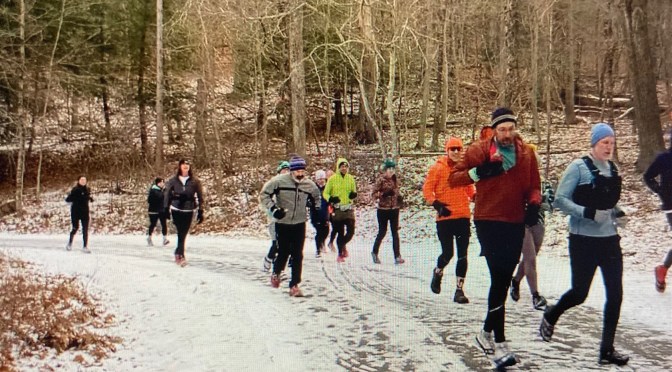
The G.A.C. Fat Ass 50K played a central role in Matt Veiga’s trail- and ultrarunning career. The event, hosted by Gil’s Athletic Club in Topsfield, introduced him to the sport in 2005 when he attended his first Fat Ass 50K. Veiga took part in the event at least 10 times, and like hundreds of runners in New England, always looked forward to the free fun run in early January that served as the unofficial kickoff to the new trail- and ultrarunning season.
When Veiga learned in November that the event would not return after a 25-year run, he wanted to do something about it.
“Like many that have been running that Fat Ass 50K for years, I was bummed,” Veiga said of his reaction to the news. “I had heard that the 2025 event was likely to be the final running last year, and that is when I first thought ‘maybe I can keep this going.’”
Veiga began looking into the logistics to understand what it would take to make it happen on a compressed time frame. He soon learned that he wasn’t the only one seeking to keep the New England classic event going. Patrick Caron of the Trail Animals Running Club posted on Instagram seeking someone interested in directing the event. Longtime G.A.C. Fat Ass 50K race director Roger Martell approached Caron at the TARC Stone Cat Trail Festival in early November to share the news. Caron previously led the effort for TARC to take over Stone Cat from G.A.C. following G.A.C.’s announcement in 2022 that it would be discontinuing the event. Martell told Caron that if TARC was interested in keeping the Fat Ass 50K going, he would support the effort. Caron recognized the importance of the family reunion-style event to the New England community and immediately went to work trying to pull it off. Unlike with Stone Cat, Caron couldn’t commit to directing the Fat Ass 50K. Veiga had the desire to do so, and he promptly reached out to Caron to offer his service.

“By the time I had heard TARC was interested in taking over the event I had already looked into permitting and resigned that it couldn’t be pulled off this year,” Veiga said. “To put it simply, I was pumped when I saw Pat make a post on Instagram looking for a race director. Having never put a race together, it would have been nearly impossible to put the pieces together in a month without his guidance. The day after responding to Pat’s post, we were on the phone and he was giving me the cliff notes version of what needed to be done to make the event happen.”
The biggest challenge to overcome during the compressed timeline was obtaining a permit for the event.
“There is a 45-day deadline for permitting and we were 30 days out from the event date,” Veiga explained. “The day after our initial call, Pat and I got on a video call to submit the permit application and finalize what the event would look like. So the brunt of the planning happened in three days. After a two-week wait and visit to the ranger at Bradley Palmer, we got the go-ahead for the event on December 23 and opened registration on December 26. The rest came together pretty seamlessly due to some great volunteers and the low-key nature of this event.”
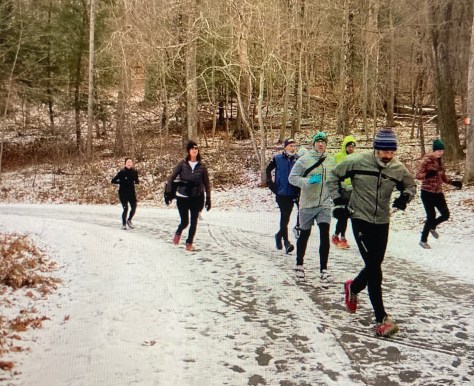
After a whirlwind few weeks, Veiga welcomed around 150 runners to the starting line on Saturday, Jan. 3, at Bradley Palmer State Park in Hamilton, Mass., for the latest edition of the fun run. Many of the faces were familiar folks who’ve been regulars during the past 25 years, joined by dozens of first-timers like Veiga had been two decades ago. The 10K loop course was the same that runners and walkers have taken on in recent years, and folks still had the opportunity to complete up to five loops, with those doing so earning credit for 50K finishes. They could also complete four loops and a separate out-and-back for marathon credit. The only minor difference from years past was the event name: the 26th edition of the event was its first under the moniker TARC Yeti Trail Trot.
Participants were treated to slippery conditions on a cold, cloudy day when the high temperature barely touched 30 degrees.
“Course conditions were less than ideal,” Veiga noted. “The majority of the course was thick glaze ice making for tough footing. I would say at least five miles of the 10K course was an ice rink. Spikes – as annoying as they are to run in – were a necessary evil. Despite the slippery footing, many of the participants were out there going the distance as a final long run for the Frozen Yeti coming up (in early February).”
Of those who took part in the event, 31 completed five loops of the course and earned 50K ultramarathon finishes. Tom Hanlon, 27, of Waltham, Mass., was the fastest in the field and the lone sub-4-hour finisher, winning in 3:40:48. It was a strong kickoff to a year that will see Hanlon race the historic Western States Endurance Run 100-miler in late June. Jonathan Western, 41, of Topsfield, Mass., was second in 4:20:36, and 29-year-old Josh Mighill of Woonsocket, R.I., rounded out the male top three in 4:49:00. Joseph Blackburn, 30, of Loudon, N.H., was the final sub-5-hour finisher in 4:53:00.
The fastest female runners were in close contact throughout and ultimately separated by less than 5 minutes at the end. Jennifer Boshco, 51, of Dover, N.H., was the top finisher in 5:00:28, earning the victory following back-to-back runner-up finishes in 2023 and 2024. She was followed by 38-year-old Miki Sawada of Brighton, Mass., in 5:05:00. Charlotte Kelley, 33, of Medford, Mass., was third in 5:29:00.
In addition to the 50K finishers, another 11 runners earned marathon finishes by completing four loops of the course along with an additional out-and-back. Todd Callaghan, 56, of Beverly, Mass., led the way in 3:37:00, followed by Gregory Lowe, 61, of Newbury, Mass., in 4:26:00, and Sasha McGurrin, 51, of Beverly, Mass., in 4:56:42. Rebecca Hill, 52, of Ipswich, Mass., and Lori Wetzel, 52, of Beverly, Mass., ran together, finished together and topped the female field in 5:40:18, followed by Jennifer Rizzo, 42, of Marblehead, Mass., in 6:05:15.
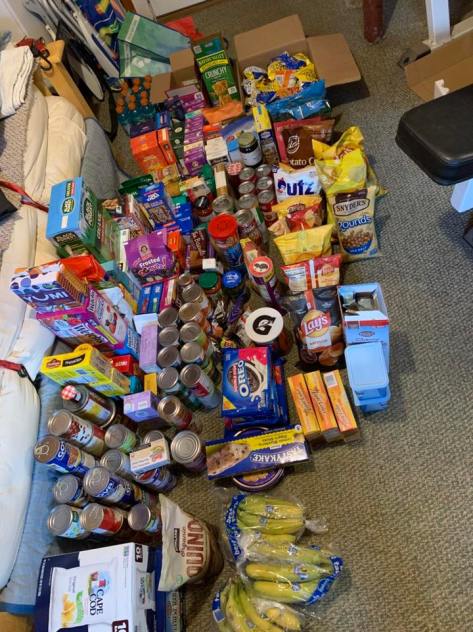
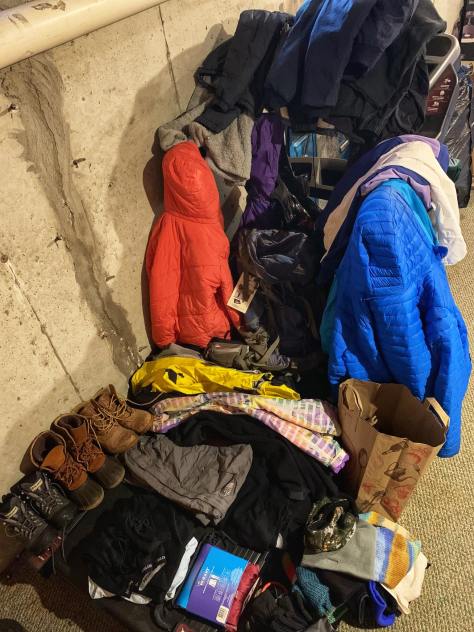
In keeping with tradition established by G.A.C., the event once again encouraged participants to bring donations to support good causes in the community. This year, runners amassed a large collection of food items that were donated to the Salem Food Pantry. Additionally, an assortment of winter gear was collected for donation to Hale Education’s Intrepid Academy, a tuition-free program that supports high school students in having outdoor learning experiences.
Following a successful day of bringing the trail- and ultrarunning community together and preserving a New England tradition, Veiga reflected on the day. He was thankful to keep the event going for so many people who have been a part of its history, some for only the first or second time, and others for a quarter-century. He was also thankful to have had the opportunity to give back to an event – and a community – that have had such a profound impact on him through the years.
“It is tough to put into words what taking over this event meant to me,” he said. “I have been a part of the New England running community for 25 years and was first introduced to GAC back in 2005 when I first learned about ultra distance events. Back in those days I was the speedy college kid who showed up at the group runs and track workouts. My first marathon was at Stone Cat, as was my first 50-miler. Needless to say, without knowing it, GAC guided me into ultrarunning. Taking over this event was a reconnection to the community for me. I’ve battled injuries that have not allowed me to race the past few years, and what I’ve learned is that it is the community and history that has drawn me in for so long; the running is just a bonus.
“Going into this event, I saw it as a chance to reconnect with that community while also giving back. In the first two days of registration being open we had 100 people signed up, and by a week we had 200. I was blown away. Seeing that meant so much to me. The registration list was a who’s who of local runners and many families coming out to run. I couldn’t have asked for more as my first foray into race directing. Having the opportunity to keep such a beloved and historical event going in the community that I grew up in is a true gift.”
Veiga is already looking forward to directing the event again. Unlike this year, planning and preparation shouldn’t be nearly as frantic in the future. Veiga said a date for next year’s run has already been set: January 2, 2027.
“As long as I’m at the helm of this event it will remain the free community gathering it is known for: an opportunity for everyone to come out to do a new year’s long run and connect. This year was a learning year, and we will be back to full speed for 2027.”
 MassUltra
As the former race director I am happy to see the FatAss continue. Best of luck and looking forward to 1/2/27.
LikeLike